Saturday, 27 June 2015

What is Java EE


Whenever you have felt the need of handling collections of objects, you never began by developing your own arraylist; you implement the collection API (application programming interface). Similarly, whenever you need a simple Web application or a transactional or a distributed application which is secure and interoperable, you never develop all the low-level APIs: all you do is use the Enterprise Edition of Java. We know that Java Standard Edition (Java SE) supplies us an API to handle collections, similarly Java EE supplies us a standard way to handle messaging with Java Message Service (JMS), transactions with Java Transaction API (JTA), or persistence with Java Persistence API (JPA). Java EE is nothing more than a set of specifications intended to be used while developing enterprise applications. It is an extension of Java SE to some extent which facilitates the development of distributed, powerful, robust, and highly reliable applications.

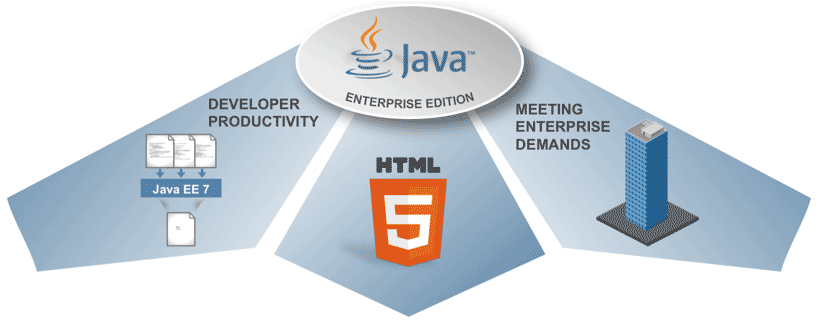
Java EE 7 has turned out to be a very valuable asset as it follows the principles of Java EE 6 by ensuring that the development model is easy, but it also includes newer specifications. New functionalities have been added to existing specifications as well. We can say that, Context and Dependency Injection (CDI) is integrating all these new specifications. Java EE 7 has the advantages of the Java language with experience gained over the last 13 years as its release coincides with 13th anniversary of Java EE. Java EE is a well-documented platform .It has large number of experienced developers, an extremely large and welcoming community, and many live applications running on servers of various companies. Java EE is a collection of APIs used to build standard component-based multitier applications. Components need to be deployed in different containers offering a variety of services.


An Introduction to Java EE 7


Enterprises today live in world where competition is intense. So applications are needed which can fulfill their business requirements. These applications are getting more and more complex. The world is going smaller because of globalization, companies across continents doing business 24/7 over the Internet reaching different countries, have datacenters, and systems dealing with different currencies and time zones—and at the same time reducing their costs, improving the response time, storing data on reliable and secure storage, and offering several mobile and web interfaces to their customers, employees, and suppliers.

A vast majority of companies are combining these complex tasks with their existing enterprise information systems (EIS) and meanwhile developing business-to-business applications so that communication can be established with partners or business-to-customer systems through mobile and geolocalized applications. Many of the companies also need to co-ordinate data stored across the globe, processed by variety of programming languages, and routed through infinite number of protocols. All this has to be achieved without losing money. Enterprise applications have to face change and complexity, and be robust. That’s precisely why Java Enterprise Edition (Java EE) was created.

At the very beginning Java EE (originally known as J2EE) focused on challenges faced by companies back in 1999: distributed components. To achieve this distributed nature software applications have had to implement new solutions like SOAP or RESTful web services. The Java EE platform has been built to cater to these technical needs by providing several ways of working through standard specifications which are published by ORACLE. All this long, Java EE has evolved and become richer, simpler, easier to use, more portable, and more integrated.